Why we built Cause Shield
The story behind Cause Shield — why charities run serious infrastructure with almost no way to see what's going wrong, and why we built one platform to monitor it, alert on it, and make sense of it all.
Cause Shield
May 24, 2026·6 min read
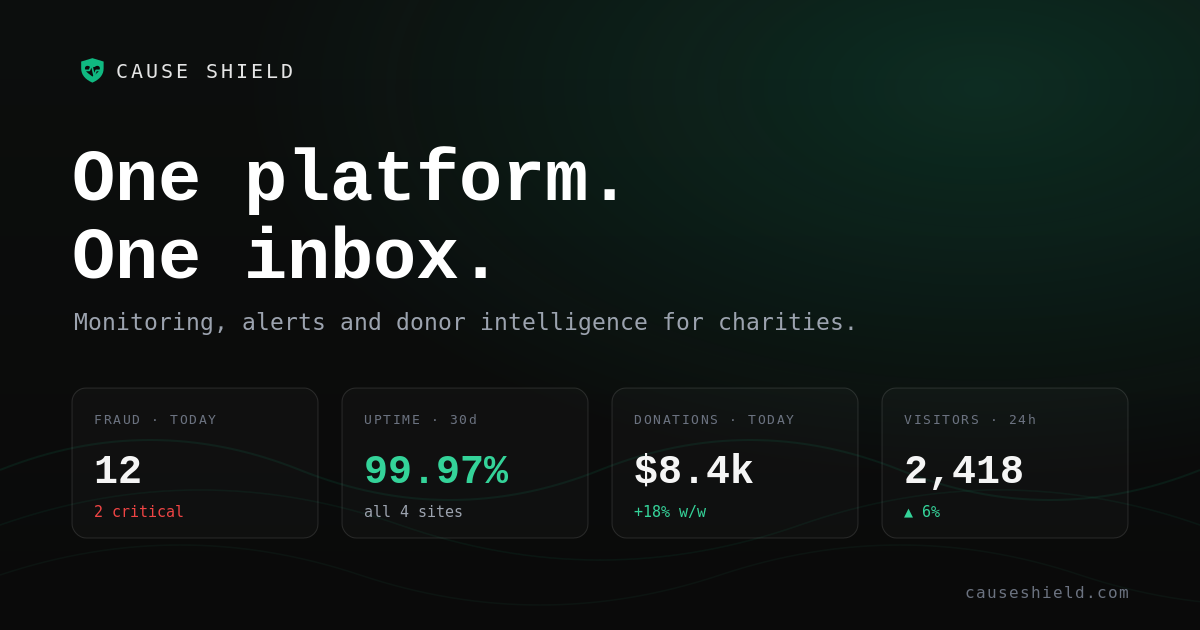
We've spent years building technology for charities — close enough to the donation forms, the payment flows and the campaign launches to see what actually goes wrong. And after enough years, you stop noticing isolated incidents and start noticing patterns.
The same problems came up again and again, across very different organisations. Card-testers working a donation form with hundreds of tiny transactions, probing stolen card numbers — each one looking like a small gift until the chargebacks landed weeks later. A donate page down for a whole weekend, discovered only when a board member asked. Recurring donors quietly lapsing — a card expires, a gift slips from $50 to $25 — with no one noticing until the year's income came in light. A donation form a supporter using a screen reader simply couldn't complete. A webhook failing in silence, so receipts stopped sending and nobody knew for weeks.
None of it was dramatic. There was rarely a single catastrophe to point at — just the same handful of small blind spots, repeating across charity after charity, each one quietly costing money, donors, or trust.
And the thread running through all of them was the same: not that these things happened, but that nobody had any way of seeing them happen. It wasn't really a fraud problem, or an uptime problem, or an accessibility problem. It was a visibility problem. That's why Cause Shield exists.
Charities run serious infrastructure — and monitor almost none of it
A modern donation operation is, underneath, real infrastructure. It takes cards, talks to Stripe, fires webhooks, issues receipts, runs across multiple sites and campaigns, and moves serious money in unpredictable spikes. In almost any other industry, infrastructure like that comes wrapped in monitoring and alerting, watched by people whose whole job is to notice when something drifts.
Charities get almost none of that — and not for lack of caring. The tools simply weren't built for them. Fraud monitoring is sold to banks. Uptime monitoring assumes you have engineers on call. Accessibility audits and security testing are priced for enterprises. Donor analytics live in one system, payment data in another, your website somewhere else again. So a charity's options have always been poor ones: buy and stitch together half a dozen tools that don't talk to each other, hire expertise you can't afford, or — most commonly — monitor nothing and hope.
We think that's backwards. The organisations with the least margin for error end up with the least visibility into what's going wrong.
The problems are scattered. The blind spot is the same.
Once we started mapping it out, the same handful of problem spaces came up again and again:
Knowing who your supporters actually are. Someone donates, registers for the fun run, sets up a peer-to-peer page, then visits the campaign site — and piecing that together today takes three tools and twenty minutes. Cause Shield threads it into one timeline per supporter, so you can see the whole relationship at a glance.
Donors lapsing without a sound. A card declines, a renewal fails, a regular gift shrinks. Most teams don't notice until the income lands light. Cause Shield scores recurring donors for churn risk and surfaces the ones worth a personal call — while there's still time to make it.
Suspicious activity on donation forms. Card-testers like charities: small amounts, recurring giving for cover, fewer fraud teams watching. Cause Shield scores every donation in real time and flags the patterns worth a closer look — bursts from the same card range, geographic anomalies, refund and chargeback velocity — so you're not first hearing about it from a chargeback notice weeks later. It flags and alerts; the decision always stays with you.
Pages that go down — or go quiet. Your platform's uptime isn't your uptime; when it hiccups, donors see a broken page. And sometimes the warning sign is silence — no donations for ninety minutes on a Thursday afternoon. Cause Shield checks your donation pages every minute, and can alert you when the activity you'd expect simply stops.
Donation journeys people can't use. Missing alt text, poor contrast, unlabelled fields — walls a screen-reader or keyboard user hits every day. Cause Shield runs an automated accessibility scan and tells you, in plain English, what to fix first.
Security and compliance you can't keep an eye on. Expiring certificates, weak security headers, DNS hygiene, a who-did-what audit trail, and where your donor data physically lives. Cause Shield keeps track of these and keeps the record — rather than leaving it to an annual scramble.
None of these is exotic. They're the ordinary ways that running money and supporters online goes wrong. The difference is that a bank has a wall of dashboards for every one of them — and a charity has had an inbox and a hope.
One platform, one inbox, plain English
What charities were missing was never a single feature. It was a single place. Somewhere that watches all of these fronts at once, connects them, and tells you — in language you don't need a security background to read — what's fine, what changed, and the one thing worth looking at today.
That's what we built. Cause Shield connects to the tools you already use, read-only, with no ability to move your money. It keeps an eye on the transactions, the uptime, the certificates, the webhooks, the accessibility of your pages, and the supporters themselves — then brings it all into one dashboard and one morning email. When something's worth your attention, it tells you, before it becomes a crisis. When everything's fine, it tells you that too.
It's deliberately platform-agnostic — Stripe, Funraisin, Raisely, Classy, GiveWP, Donorbox, whatever you run on — and it routes the right alert to the right person, so finance, IT and the executive director each see what matters to them and nothing they don't.
Built by people who know fundraising
We didn't come to this from cybersecurity. We came from fundraising — years building donation technology and watching, up close, what actually goes wrong for the charities using it. That's why Cause Shield isn't a security product bolted onto the nonprofit world; it's built around how charities actually operate. Lean teams. No time for forty-page reports. A real need to simply be told what's going on.
Every dollar lost to fraud, every hour a donate page is down, every receipt that never sends, every lapsing donor nobody got to call — is taken from a cause. We can't do the world's good work for you. But we can make sure you can see the systems underneath it, all in one place, so nothing important slips by unnoticed.
That's the why. We're glad you're here for the start of it.
Tags