Fundraising Software and Cause Shield as an Additional Tool
Your fundraising platform handles forms, pages, and payments. It wasn't built to catch fraud or flag churn risk. Here's what that gap costs Australian charities and how to close it.
Cause Shield
August 13, 2026·5 min read
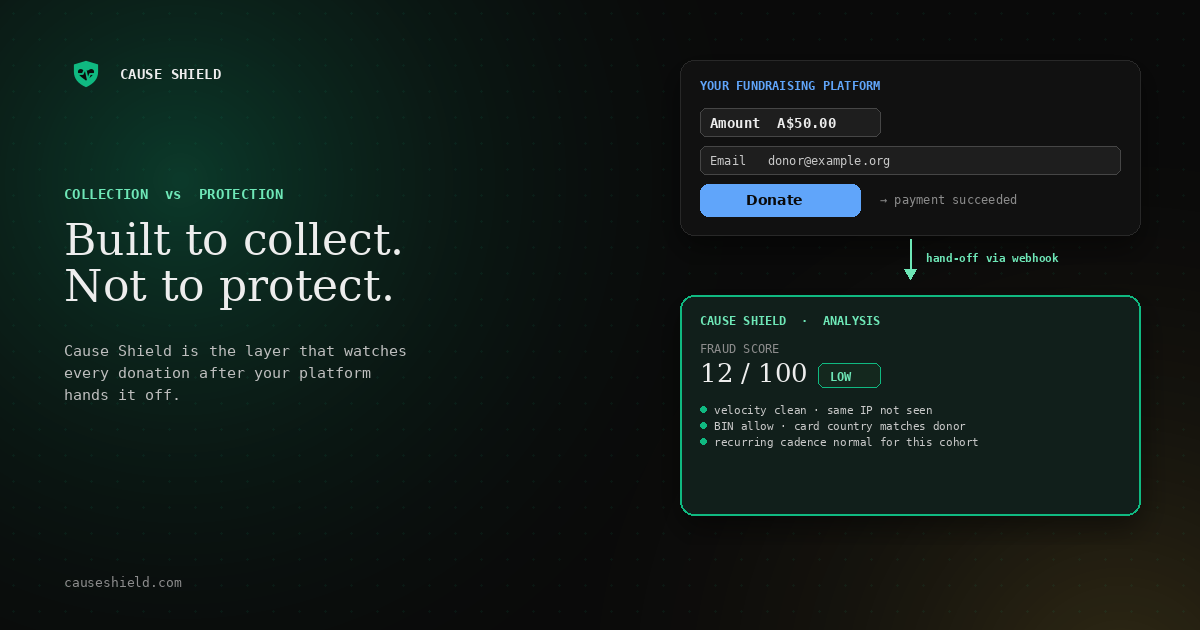
Your fundraising platform was built to collect donations, not to protect them. For most Australian charities, that distinction doesn't matter until it does: a card-testing attack drains your Stripe balance in fees, a recurring donor quietly lapses, or a refund request from a suspicious transaction lands on a Friday afternoon.
What fundraising platforms actually do (and don't do)
Platforms like Raisely, Funraisin, Classy, and GiveWP are good at what they're designed for: branded donation pages, peer-to-peer fundraising campaigns, event registrations, and routing completed transactions to your payment processor. They abstract away the hard parts of building a payment form.
What they don't do: ongoing fraud analysis on recurring charges, cross-donor velocity checks, churn-risk scoring on your regular givers, or WCAG accessibility audits on your donation page.
That's not a criticism. It's a scope decision. A fundraising platform's job ends roughly when the payment succeeds. Everything after that: is this donor real, will they give again next month, is someone running cards through your form at 3am? That's outside the product boundary.
What does card-testing look like on a charity's donation form?
Card-testing is when someone uses a public-facing payment form to validate stolen card numbers at low dollar amounts, typically A$1 or A$2, before selling the cards or using them elsewhere. Charity donation forms are a known target because:
- They're public, no login required.
- Small donations don't trigger manual review.
- Many nonprofits don't monitor transaction velocity.
A typical attack might run 200 to 400 transactions in under 20 minutes, each hitting your Stripe account and generating a A$0.30 to A$0.50 processing fee regardless of whether the card declines. That's A$60 to A$200 in fees before anyone notices, plus the Stripe dispute fees if any cards succeed and later get charged back.
Stripe Radar catches some of this on the first charge. It doesn't re-score subsequent charges. So if a card slips through on day one of a monthly recurring gift, Radar never looks at it again. Cause Shield scores every renewal, every billing cycle, against current velocity data.
Why recurring donor data is scattered across your stack
Most charities run at least two or three systems: their fundraising platform, Stripe, a CRM, maybe a separate email tool. A donor who gave through a Funraisin peer-to-peer campaign, then donated directly via your website's Raisely form, and then signed up for a monthly gift through a different page often appears as three separate records.
Operationally, that means your finance lead is reconciling manually. Your development director doesn't have a single view of that donor's total value. And no one is watching whether that monthly gift is showing churn signals: declining email open rates, a card that's been updated twice in six months, a billing address change.
This is a data plumbing problem, and it's common. The platforms don't talk to each other unless you've built the integration. Even when they do, they typically sync transaction records, not behavioral signals.
How Cause Shield fits alongside your existing platform
Cause Shield doesn't replace your fundraising platform. It sits alongside Stripe and your platform via webhooks, and it focuses on the two things those platforms don't: transaction risk and donor intelligence.
On the fraud side: every donation that hits your Stripe account gets scored by Cause Shield using the Claude API. The score comes with plain-English reasoning, not just a number. Something like: "High velocity from this BIN: 14 transactions in 40 minutes across 6 IP addresses. Likely card-testing." You see that in your dashboard. Cause Shield doesn't block the charge. Refund decisions stay with you. But you're not finding out about the attack three days later from your bank.
On the donor side (Partner tier): the Supporter Trails feature threads every transaction, registration, and peer-to-peer activity into one view per donor, regardless of which platform the event came from. The smart webhook receiver accepts payloads from Funraisin, Raisely, Classy, GiveWP, and custom platforms, and the AI classifier extracts donor identity and amount from whatever field naming the platform uses. A mid-size health charity using two different platforms for events and regular giving would see all of it in one place, with a Pulse churn-risk score on each recurring donor.
Plans start at A$49 per month for the Starter tier (2,000 fraud analyses per month) and go to A$249 per month for Partner, which includes 50,000 fraud analyses, 150,000 webhook classifications, plus monthly WCAG 2.2 AA accessibility scans and a defensive security configuration audit on your external-facing setup. If your AI allowance runs out mid-month, monitoring doesn't stop: it falls back to rule-based detection automatically, and AI scoring resumes next billing cycle. No extra charge, no gap in coverage.
Cause Shield never sees card numbers. Stripe is the system of record for payment data, so Cause Shield is outside PCI scope by design. Donor PII is SHA-256 hashed with a per-organisation pepper before storage.
What to do this month
Pull your Stripe dashboard and look at your dispute rate and your fee volume for the last 90 days. If you've had more than two or three disputes, or you can see clusters of small transactions from the same IP range, you've already had an incident. If everything looks clean, good: a 14-day free trial is a low-cost way to confirm that.
Start with your current fundraising platform and Stripe connected. You don't need to change anything about how you collect donations. The integration is additive.
Tags